Creative Phase
Value Engineering





Introduction
The Creative Phase is where Value Engineering shifts gears from analysis to imagination. Having clarified functions in the Function Analysis Phase, the team now generates alternative ways to achieve those functions. This is not casual brainstorming—it is structured, disciplined divergence. The goal is to produce a wide range of ideas without judgment, ensuring that later evaluation has a rich pool to draw from.
Purpose of the Creative Phase
- Divergence: Generate numerous, varied alternatives for each function.
- Bias control: Suspend judgment, titles, and preferences.
- Coverage: Ensure each core function has multiple options, including low-cost, modular, and lifecycle-oriented ideas.
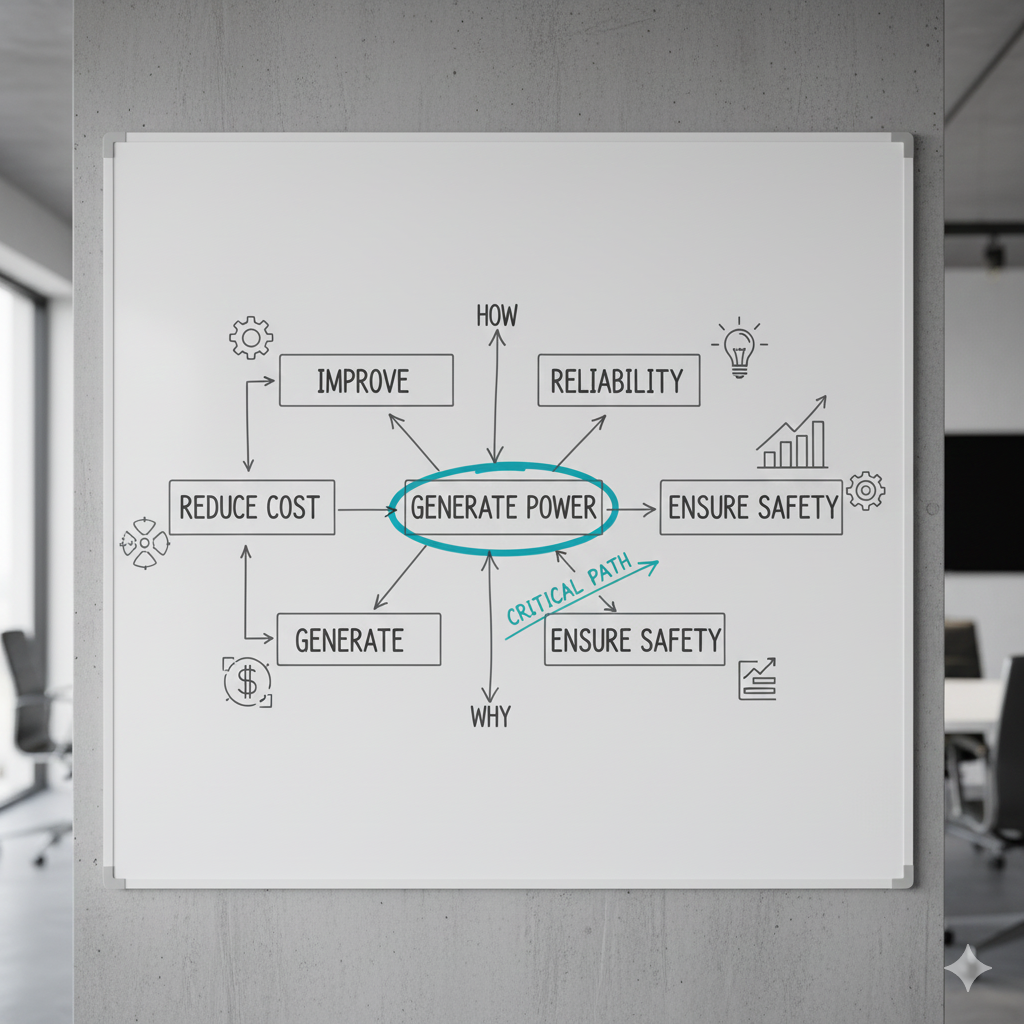
This phase answers: “How else could we achieve the required functions?”
Ground Rules for Effective Ideation
- No judgment: Critique is deferred until the Evaluation Phase.
- Quantity over quality (for now): Aim for volume; refinement comes later.
- Encourage wild ideas: Even unconventional suggestions can spark viable solutions.
- Build on ideas: Use “Yes, and…” to extend threads.
- Record everything: No idea left undocumented.
Methods and Prompts
Structured techniques prevent ideation from stalling or narrowing too quickly:
- SCAMPER: Substitute, Combine, Adapt, Modify, Put to another use, Eliminate, Reverse.
- TRIZ patterns: Contradiction resolution, segmentation, dynamicity, local quality.
- Constraint flips: Turn constraints into design catalysts.
- Analogy prompts: Borrow strategies from unrelated domains.
- Modularity prompts: Break big solutions into swappable modules.
- Lifecycle prompts: Shift cost/benefit across CapEx and OpEx.
Process Steps (Checklist)
- Prep from Function Analysis
Select high-impact functions and cost hotspots. - Ideation rounds
Run 3–5 timed sprints, each using a different method (SCAMPER, TRIZ, analogy). - Synthesis board
Cluster ideas by function, technology, cost tier, and risk. - Feasibility quick-markers
Label ideas “speculative,” “plausible,” or “known” (no scoring yet). - Document thoroughly
Capture title, one-liner, enabling principle, and dependencies.
Tools and Templates
- Idea cards: Function, principle, brief description, enabling tech.
- Divergence tracker: Counts per function to avoid gaps.
- Cluster map: Affinity diagram linking ideas to functions and costs.
- Constraint flip deck: Prompts to convert limits into opportunities.
Deliverables and Acceptance Criteria
- Idea library: 30–60 alternatives across core functions, categorized and documented.
- Coverage report: Minimum 3 alternatives per basic function; 2 per major secondary function.
Acceptance criteria:
- Judgment deferred; no premature screening.
- Ideas documented with enabling principles.
- Stakeholder review limited to clarifications, not selection.
Common Pitfalls
- Early judgment: Kills novelty and limits search space.
- Single-method reliance: Produces narrow, predictable ideas.
- Function neglect: Over-ideating on familiar areas; ignoring essential functions.
- Poor documentation: Ideas lost, duplicated, or misunderstood later.
Example (Mini Case)
For the function “Transfer heat,” a team used TRIZ “segmentation” to propose microchannel exchangers, SCAMPER “Combine” to integrate heat recovery into an existing loop, and “Reverse” to consider batch heating to reduce peak energy. Combined, these expanded options yielded a final concept that reduced operating costs by 18% after evaluation.
Transition to the Next Phase
The Creative Phase feeds the Evaluation Phase, where ideas are screened, scored, and ranked using feasibility, cost, and performance criteria.
CTA: Download the ideation pack (SCAMPER + TRIZ prompts + idea cards).
![[AI agent assisting an engineering team with a digital FAST map and value engineering brainstorming in 2026]](https://learning.malyomar.com/wp-content/uploads/2026/01/value-engineering-ai-save-international-240x142.png)