Function Analysis Phase
Value Engineering




Introduction
The Function Analysis Phase is the intellectual core of Value Engineering. It takes the raw data collected in the Information Phase and translates it into a functional model—a map of what the system must do, why it must do it, and how those functions interact. This phase is not about design solutions; it is about stripping a project down to its essential purposes and exposing where costs are justified—or not.
The hallmark tool of this phase is the FAST (Function Analysis System Technique) diagram, but the mindset is even more important: thinking in verbs and nouns rather than parts and preferences. By focusing on functions, teams uncover opportunities for innovation and cost optimization that would otherwise remain hidden.
Purpose of the Function Analysis Phase
- Clarify essential functions: Identify the basic function (the project’s core purpose) and distinguish it from secondary functions (support, aesthetics, compliance).
- Expose value patterns: Reveal where costs cluster around low-value functions.
- Build a shared model: Create a functional map that stakeholders can understand, critique, and use to guide creative ideation.
In short, this phase answers: “What must the project do, and how do its functions relate?”
Fundamentals of Functional Thinking
- Verb–noun definition: Functions should be expressed in two words, e.g., “Heat fluid,” “Prevent leakage,” “Guide flow.”
- Measurability: Each function must be testable—flow rate, temperature range, leak rate.
- Avoid design bias: Functions should not embed solutions. For example, not “Install exchanger,” but “Transfer heat.”
- Constraints vs functions: Constraints (e.g., “Meet environmental regulation”) influence functions but are not functions themselves.
FAST Diagram Basics
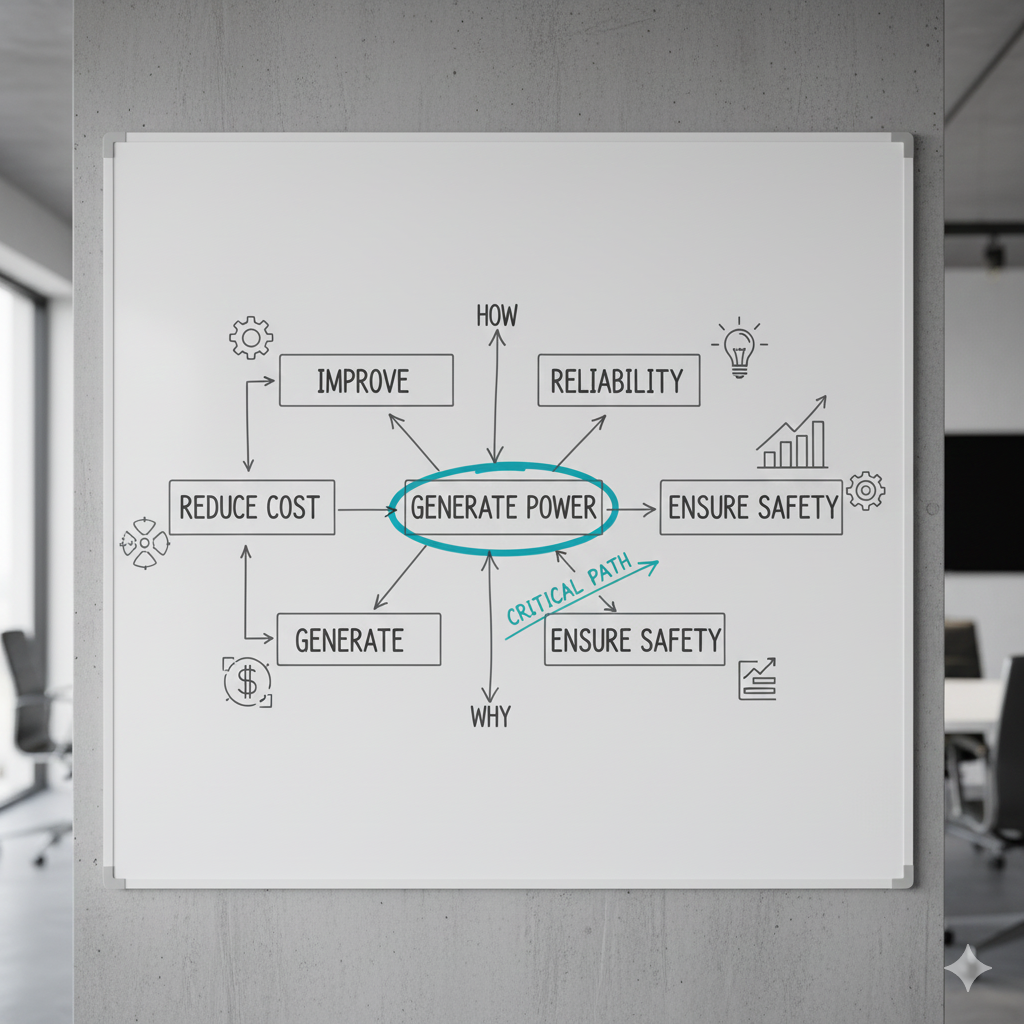
The FAST diagram is the visual language of function analysis.
- Horizontal logic:
- To the right: “How?” functions (implementation steps).
- To the left: “Why?” functions (higher-order purpose).
- Vertical logic:
- Above: “When?” or “Under what conditions?” (constraints, triggers).
- Below: “Supporting” or “secondary” functions.
- Basic function: The anchor, often left-center (“Why?” of the system).
- Secondary functions: Comfort, aesthetics, serviceability, compliance—necessary but often prone to over-specification.
Process Steps (Checklist)
- Gather candidate functions
Extract verb–noun statements from the Information Phase data. - Validate and refine
Remove solution-laden phrases, enforce measurability, and group duplicates. - Classify basic vs secondary
Identify the one or two essential functions; tag the rest as secondary. - Construct the FAST diagram
Lay out “How?” to the right, “Why?” to the left, conditions above, supports below. - Stress test with stakeholders
Review for clarity; challenge assumptions; reconcile with constraints. - Link to costs
Annotate the diagram with cost drivers per function to reveal low-value clusters.
Tools and Templates
- Verb–noun function list
- FAST diagram canvas (with arrows and lanes for conditions/supports)
- Function–cost matrix (function rows, cost columns, value ratio notes)
- Secondary function heatmap (highlight where most spend isn’t tied to core purpose)
Deliverables and Acceptance Criteria
- Functional model: FAST diagram agreed and versioned.
- Function registry: Measurable definitions and acceptance tests per function.
- Function–cost annotation: Preliminary mapping of cost drivers to functions.
Acceptance criteria:
- All functions in verb–noun form, measurable.
- Basic function clearly identified and justified.
- Stakeholder sign-off on the FAST diagram.
Common Pitfalls
- Design bias: Functions that smuggle in specific solutions.
- Function sprawl: Too many “secondary” functions treated as sacred.
- Missing measurement: Vague functions that can’t be validated.
- No link to cost: Functional model without economic context.
Example (Mini Case)
A water treatment plant’s basic function was “Make water potable.” The FAST diagram revealed secondary functions like “Reduce noise,” “Hide equipment,” and “Enhance aesthetics” consuming nearly 10% of the budget. By reframing “Hide equipment” as a constraint in one zone, the team reduced spend on architectural cladding and reallocated funds to “Optimize energy use” for aeration. The result was a better value balance without compromising community expectations.
Transition to the Next Phase
With a functional model and FAST diagram in place, the team is ready for the Creative Phase, where alternative ways to achieve each function are generated—without judgment.CTA: Download the FAST diagram template and the verb–noun function checklist.
![[AI agent assisting an engineering team with a digital FAST map and value engineering brainstorming in 2026]](https://learning.malyomar.com/wp-content/uploads/2026/01/value-engineering-ai-save-international-240x142.png)