From Blueprint to Reality: Pipe Fabrication in the Workshop 3/7
Piping Construction


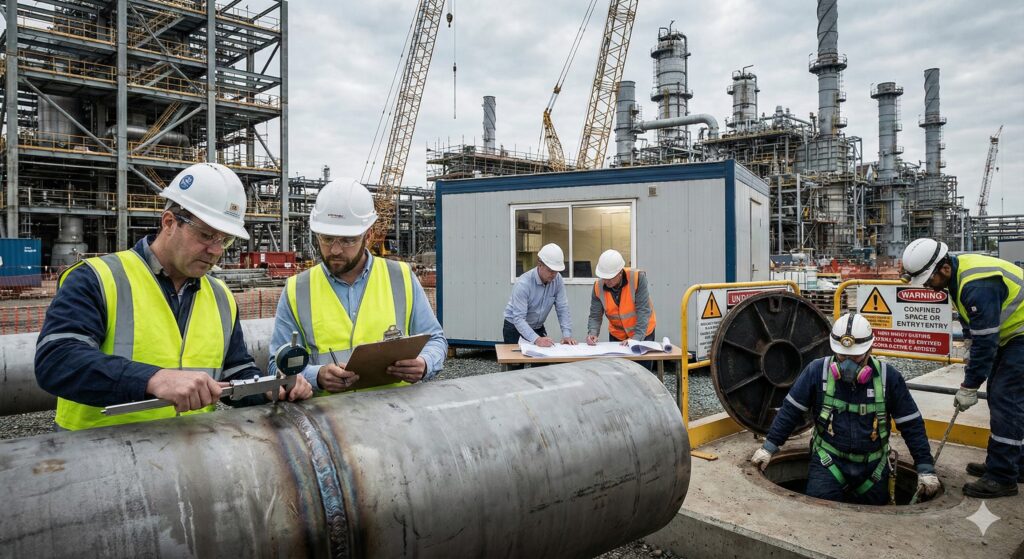

Introduction: The Workshop as a Forge of Precision
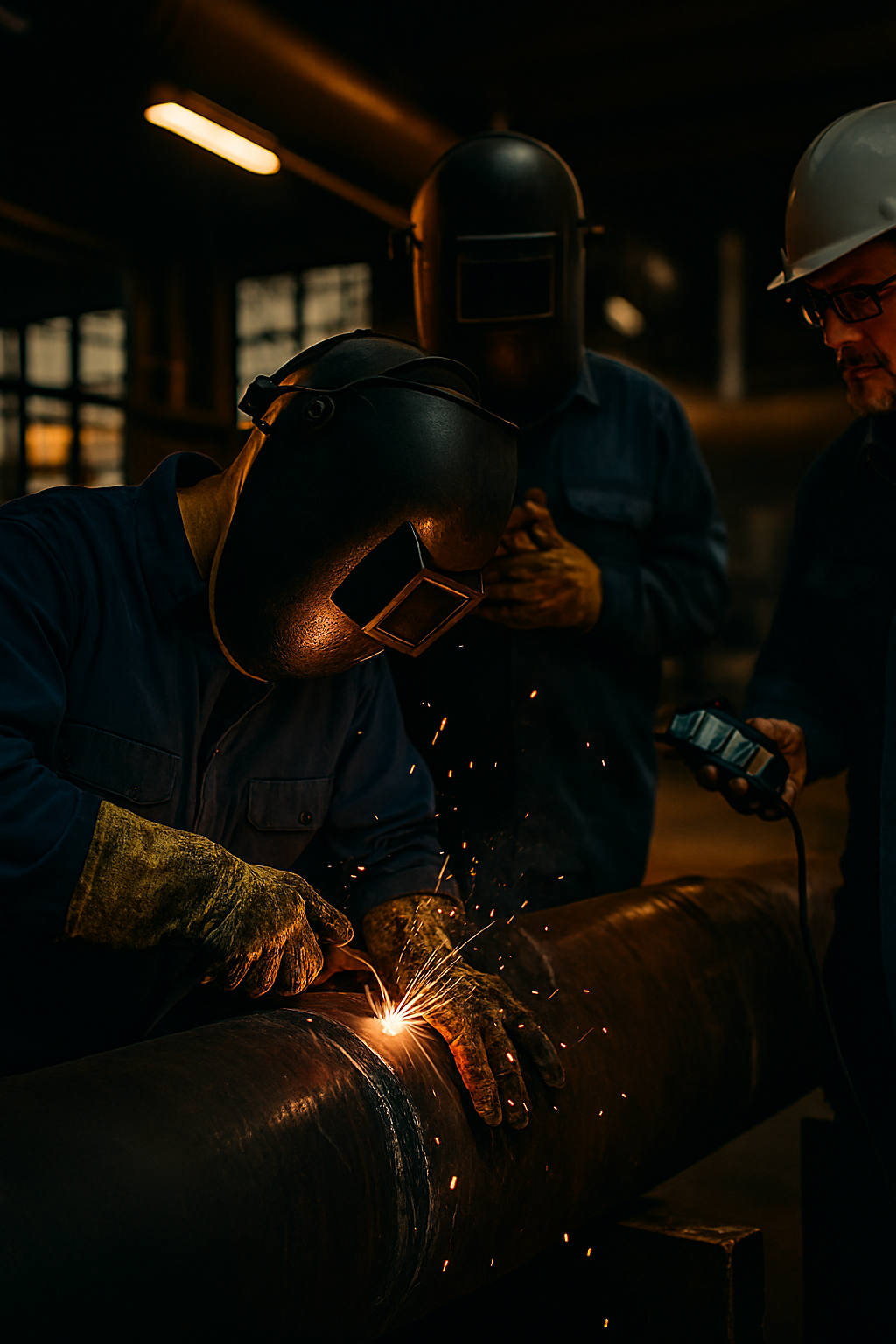
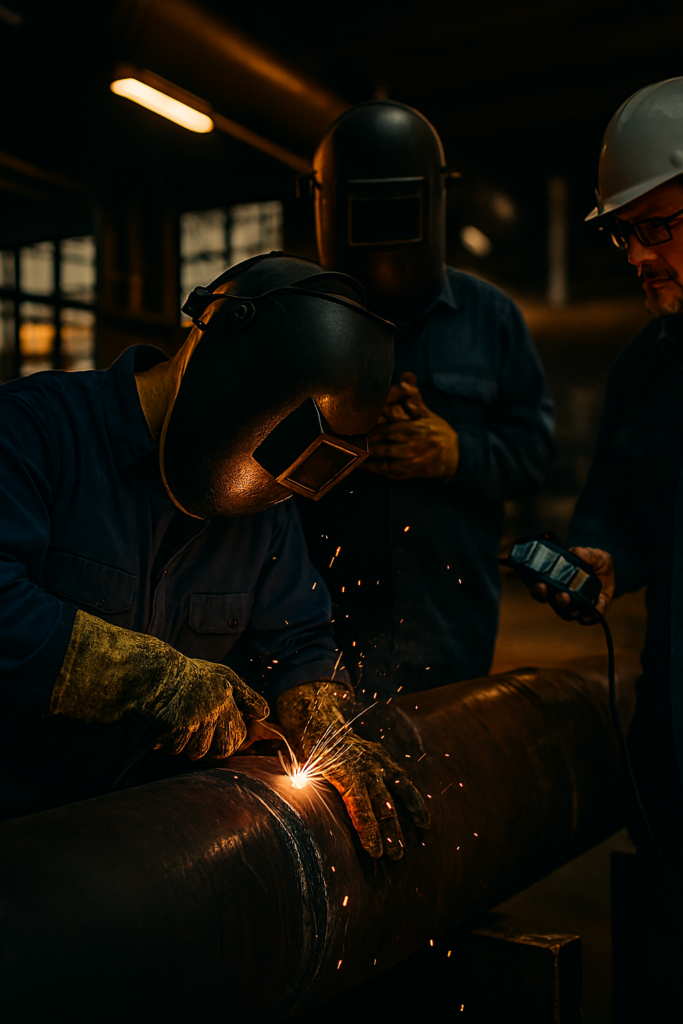
In the quiet hum of a fabrication shop, steel comes alive. Sparks fly, grinders roar, and welders lean into their craft. This is where drawings become spools — where planning meets metal.
On a gas processing project in Port Said, a fabrication foreman once said, “We don’t just weld pipes. We build trust — one joint at a time.” That trust begins with precision, discipline, and standards.
Cutting & Beveling: Preparing the Edges for Integrity
Before a weld can be laid, the pipe must be cut and beveled — shaped to receive heat and filler metal.
- Cutting methods: band saws, plasma cutters, CNC machines.
- Beveling standards: ASME B16.25 defines groove angles and land dimensions.
A real lesson: On a high-pressure steam line, a pipe was beveled with excessive land thickness. The root pass failed to penetrate, causing lack of fusion. Re-beveling and re-welding cost two days and required requalification.
Best practices:
- Use calibrated beveling tools with angle verification.
- Inspect bevels for burrs, contamination, and uniformity.
- Match bevel profile to WPS requirements.
Fit‑up & Tacking: Aligning for Strength and Flow
Fit-up is the art of alignment — ensuring pipes meet with the right gap, angle, and orientation.
- Tools used: pipe jacks, clamps, wedges, laser alignment.
- Tack welding: temporary welds to hold position before full welding.
On a desalination plant, poor fit-up led to a 3mm misalignment in a 24” spool. The tie-in flange didn’t mate, requiring field rework. The root cause? A tack weld that pulled the pipe out of alignment.
Fit-up checklist:
- Confirm root gap per WPS.
- Use spirit levels and laser tools for alignment.
- Inspect tack welds for cracks and slag.
- Record fit-up dimensions for QC traceability.
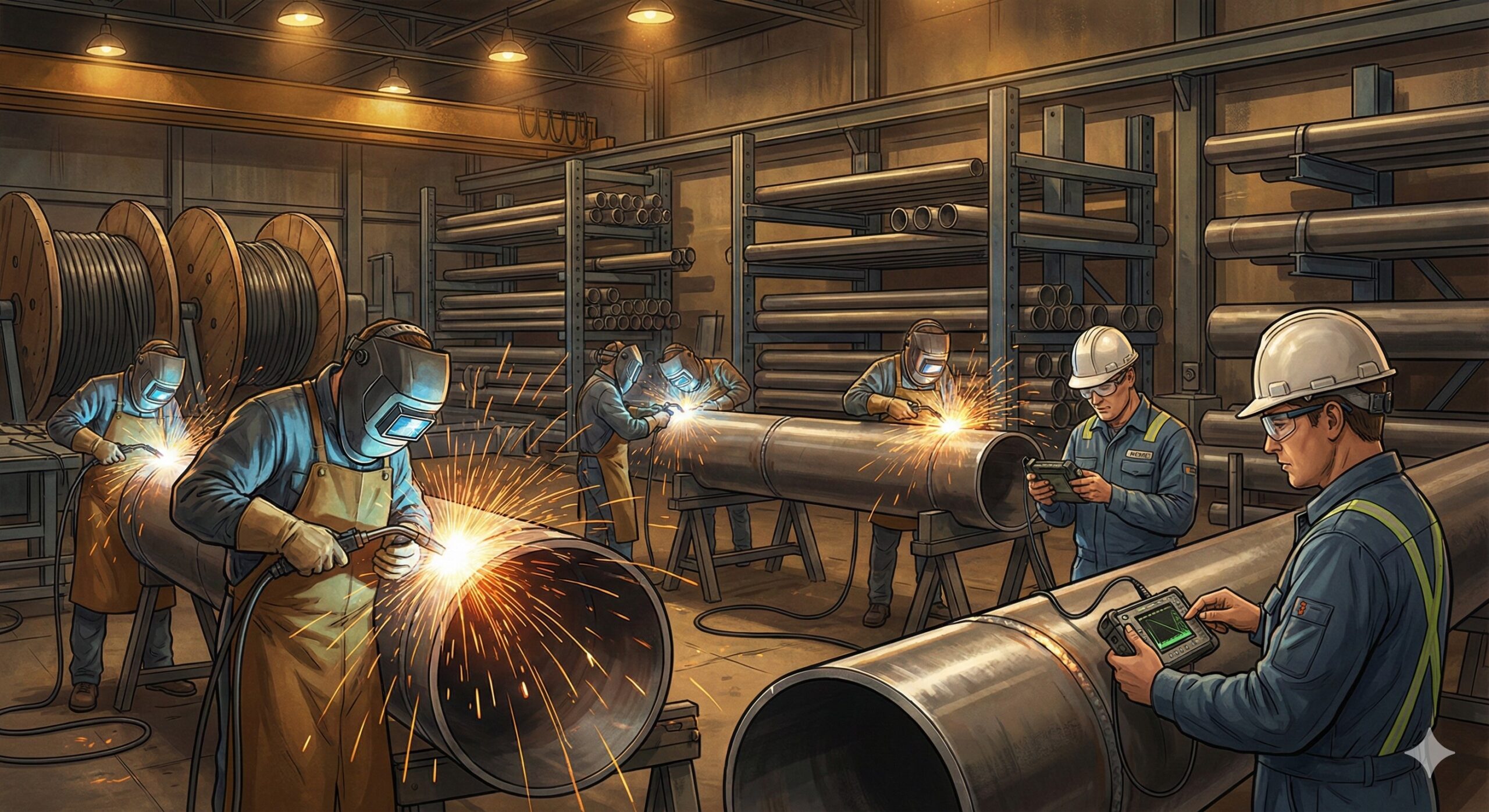
Welding Processes: GTAW, SMAW, FCAW in Action
Welding is where heat meets metallurgy — and where skill meets procedure.
- GTAW (TIG): clean, precise, ideal for root passes and thin wall pipes.
- SMAW (Stick): versatile, robust, used for field and shop welds.
- FCAW (Flux-core): high deposition rate, suited for thick wall and structural welds.
Each process must follow a WPS qualified under ASME Section IX, and each welder must be certified for the position, process, and material.
Anecdote: On a fertilizer project, GTAW was used for stainless steel root passes. One welder skipped purging — the weld oxidized internally. It passed visual but failed radiography. Lesson: procedures exist for a reason.
Welding essentials:
- Maintain interpass temperature per WPS.
- Use purge gas for stainless and alloy steels.
- Clean electrodes and filler rods before use.
- Record welder ID and weld sequence for traceability.
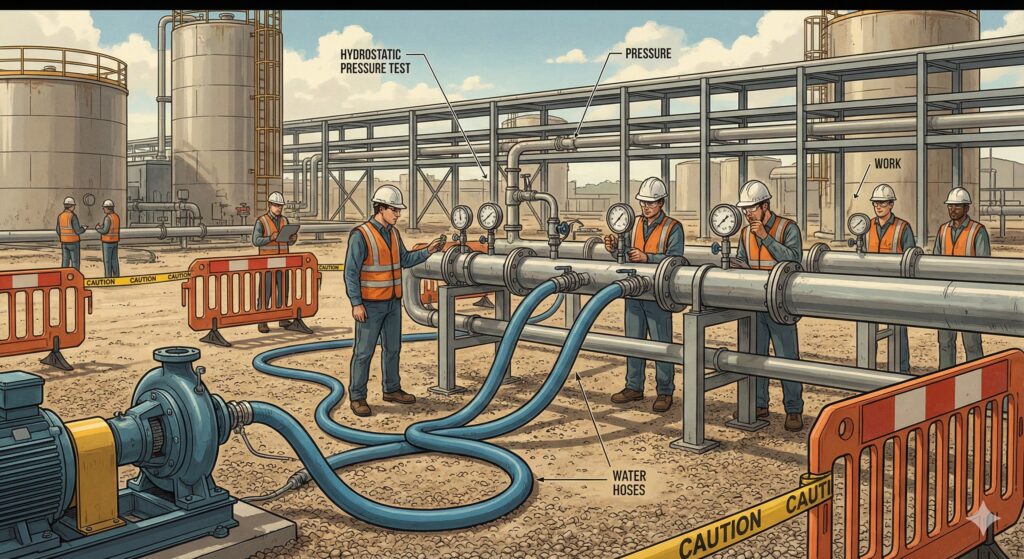
Not all defects are visible. That’s where Non-Destructive Testing (NDT) comes in.
- Radiographic Testing (RT): detects internal flaws like porosity, lack of fusion.
- Ultrasonic Testing (UT): measures wall thickness and detects laminations.
- Dye Penetrant Testing (PT): reveals surface cracks.
- Magnetic Particle Testing (MT): used on ferromagnetic materials.
Inspectors must be qualified under ISO 9712 or equivalent national standards.
Real project lesson: On a chemical plant, RT revealed a cluster of slag inclusions in a critical weld. The welder had skipped slag removal between passes. The weld was cut out and redone — but the lesson stuck.
Inspection protocol:
- Review WPS and weld maps before testing.
- Calibrate NDT equipment daily.
- Record defect type, location, and disposition.
- Maintain traceable inspection logs for client handover.
Fabrication Documentation: The Paper Behind the Pipe
Every spool fabricated must be traceable — from heat number to weld ID.
- Spool sheets: show dimensions, weld numbers, and material specs.
- Weld logs: record welder ID, process, and inspection results.
- Material certificates: confirm compliance with ASME/API specs.
On a refinery job, a missing MTC (Material Test Certificate) delayed shipment by 48 hours. The pipe was compliant — but undocumented.
Documentation tips:
- Digitize spool sheets for easy retrieval.
- Link weld logs to NDT reports.
- Store MTCs in a searchable database.
- Include fabrication photos for visual traceability.
The Human Side of Fabrication
In one shop, a welder named Hossam kept a notebook of every weld he laid — date, pipe size, filler rod, mood. “I like to remember what I felt when I welded,” he said. That’s the soul of fabrication: not just heat and metal, but pride and memory.
Conclusion: Fabrication as the Foundation of Installation
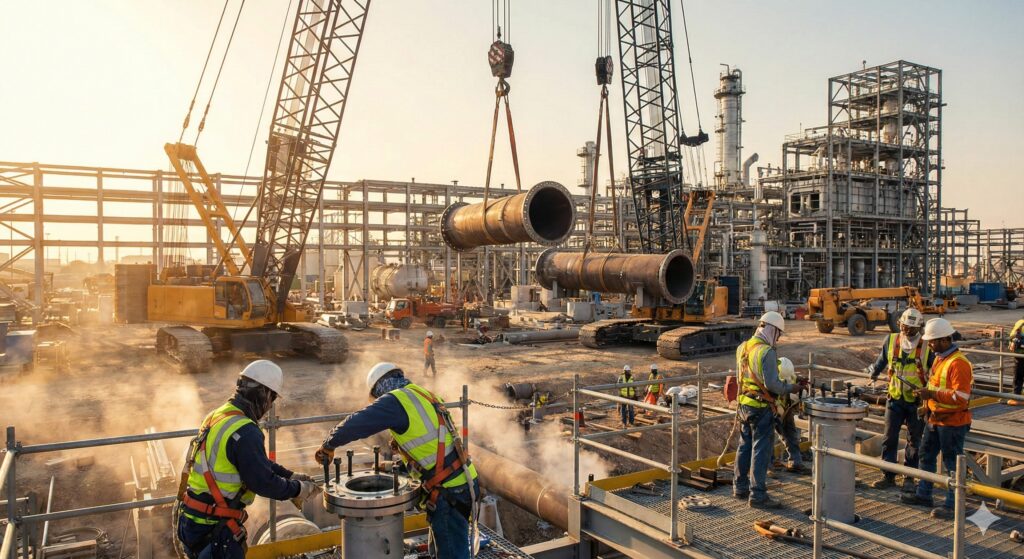
Shop fabrication is the heartbeat of piping construction. When done right, it makes field installation smooth, safe, and predictable. When rushed, it echoes in delays, defects, and disputes.
Precision, documentation, and discipline — these are the pillars of fabrication.
👉 Next Post: Field Installation
![[A human lead engineer in a high-tech construction command center directing a team of digital AI agents in 2026]](https://learning.malyomar.com/wp-content/uploads/2026/01/collaborative-ai-construction-leadership-240x142.png)