Laying the Groundwork: Pre‑Construction Planning in Piping Projects 2/7
Piping Construction


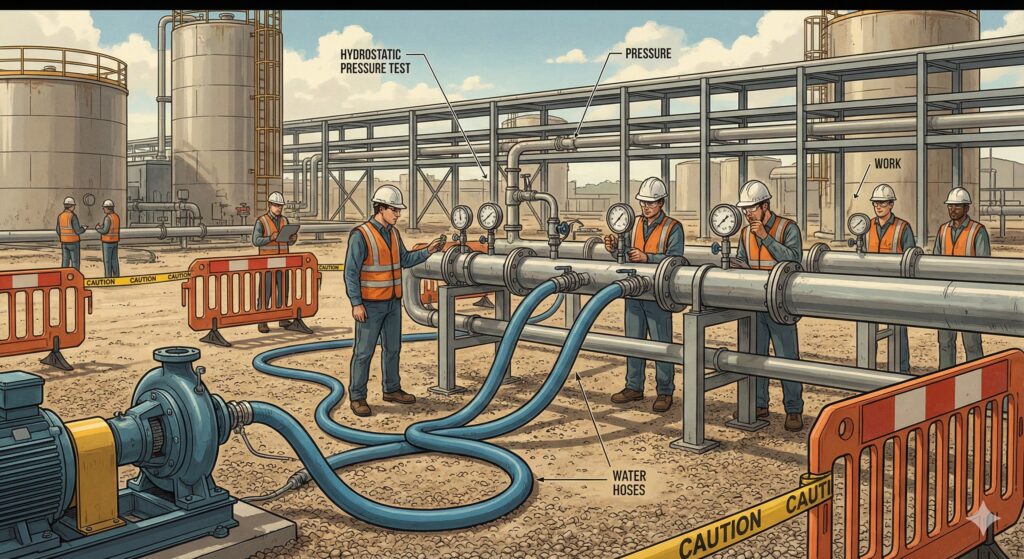
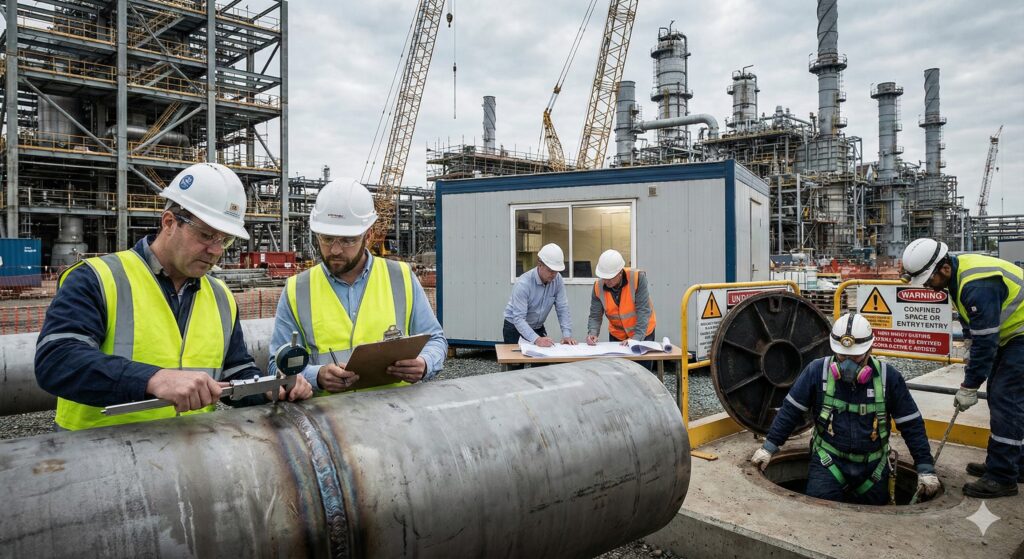
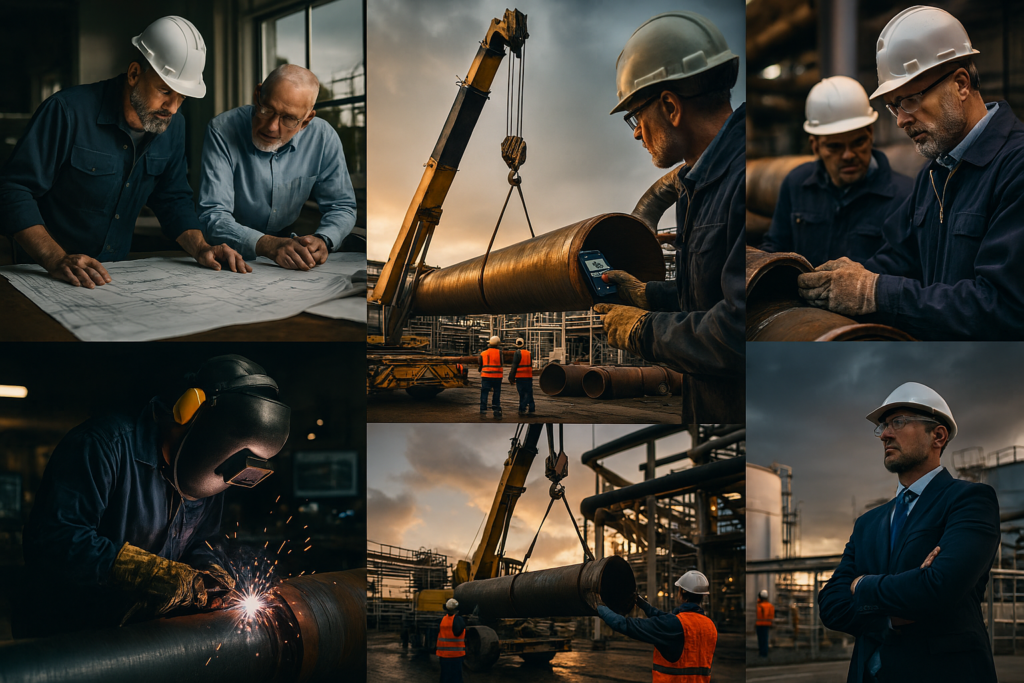
Here’s the full draft of Post 1: Pre‑Construction & Planning, written in your requested style — detailed, narrative-driven, and optimized for technical professionals. It blends global standards (ASME/API), real project lessons, and storytelling flow.
Introduction: Planning Is the First Weld
In piping construction, the first weld isn’t laid in the shop — it’s laid in the planning room. Before steel meets torch, a web of decisions unfolds: materials, drawings, logistics, procedures. Each choice echoes through the project’s lifecycle.
On a refinery expansion in Alexandria, a project manager once said, “We lost two weeks because someone chose the wrong alloy. That mistake was made in a spreadsheet, not on site.” That’s the power — and peril — of pre‑construction planning.
Material Selection & Specs: The DNA of the System
Choosing pipe materials isn’t just about cost — it’s about chemistry, pressure, temperature, and corrosion resistance.
- ASME B31.3 governs process piping, defining allowable stresses, temperature limits, and material compatibility.
- API 570 helps inspectors assess degradation over time, especially in aging systems.
A real lesson: On a petrochemical job, a junior engineer selected A106 Grade B for a high‑temperature line. It passed procurement but failed during hydrotest due to creep deformation. The spec should’ve been A335 P11. That mistake cost $40,000 in rework.
Checklist for spec selection:
- Confirm design pressure and temperature
- Cross‑check fluid type and corrosion potential
- Align with client’s preferred vendor list
- Validate against ASME/API material tables
Drawing Review: P&ID and Isometrics as the Map and Compass
Drawings are more than lines — they’re the language of the system.
- P&ID (Piping & Instrumentation Diagram): Shows process flow, control logic, and safety devices.
- Isometric Drawings: Translate P&ID into 3D spool geometry, weld locations, and support points.
On a fertilizer plant, a misdrawn valve orientation in the P&ID led to a field install that blocked access to an emergency shutoff. It was caught during a pre‑construction review — saving lives and litigation.
Best practices:
- Conduct interdisciplinary drawing reviews (process, mechanical, instrumentation)
- Use color‑coded markups for revisions
- Validate valve accessibility and flow direction
- Confirm tie‑in points with existing systems
Site Survey & Logistics: The Terrain Beneath the Blueprint
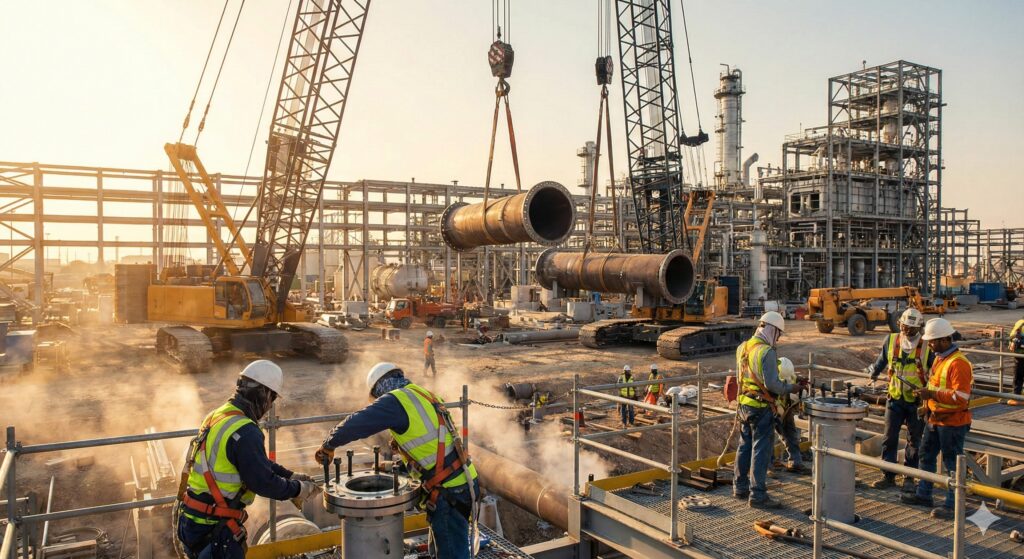
A drawing doesn’t show mud, wind, or crane swing radius. That’s where site surveys come in.
- Topographical mapping ensures spool delivery routes are feasible.
- Crane access planning prevents lifting delays.
- Material laydown zones must be secure and weather‑resistant.
On a desert site near Ain Sokhna, a project nearly stalled when the laydown area flooded during a rare storm. The site survey had missed drainage planning. A $5,000 trench saved a $500,000 delay.
Survey essentials:
- Walk the site with drawings in hand
- Mark crane paths and lifting zones
- Identify confined spaces and hot work areas
- Coordinate with civil and safety teams
Welding Procedure Specifications (WPS): The Blueprint for Heat and Skill
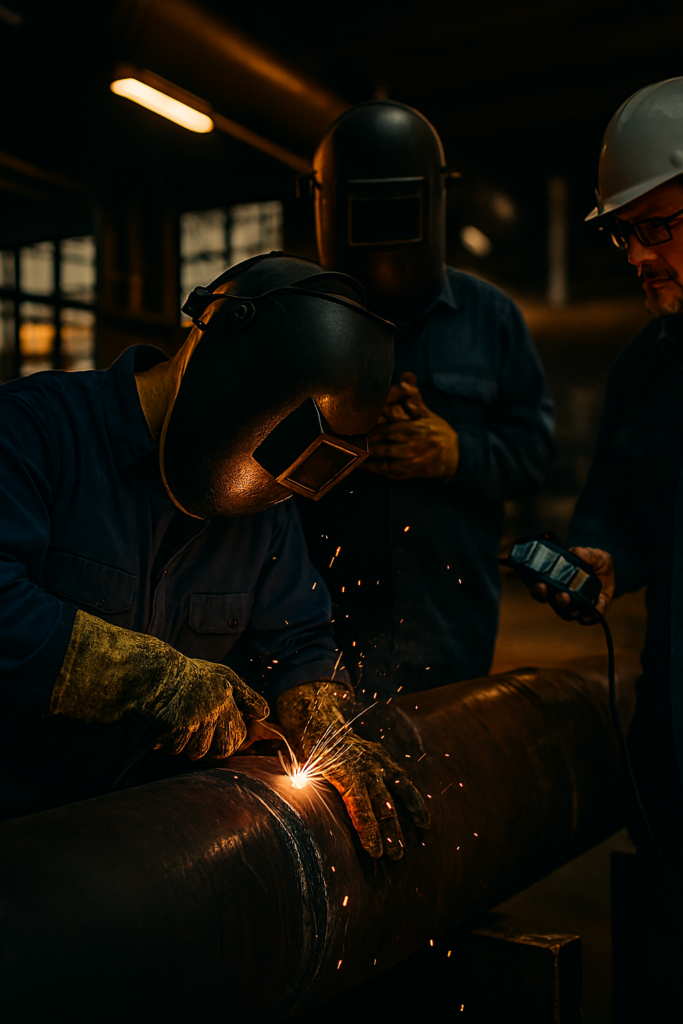
Welding isn’t just a skill — it’s a qualified procedure.
- ASME Section IX defines how WPS must be qualified through PQR (Procedure Qualification Record).
- Each welder must be tested and certified for the specific process (GTAW, SMAW, FCAW).
On a high‑pressure steam line, a welder used SMAW without backing gas — violating the WPS. The weld cracked during commissioning. Requalification and repair cost 12 days.
WPS planning tips:
- Develop WPS for each joint type and position
- Qualify welders early to avoid bottlenecks
- Include preheat, interpass, and post‑weld heat treatment specs
- Align with client’s inspection and NDT requirements
The Human Side of Planning
Planning isn’t just technical — it’s emotional. It’s the moment when teams align, when risks are named, and when trust begins.
In one project kickoff, the lead inspector said, “If we get this week right, the next six months will feel like choreography.” That’s the goal: to turn chaos into rhythm.
Conclusion: Planning as the Invisible Backbone
Pre‑construction planning is invisible on site — but its fingerprints are everywhere. In every weld that fits, every valve that’s accessible, every spool that lifts without a hitch.
It’s not glamorous, but it’s sacred. Because when planning fails, everything else follows.
👉 Next Post: Pipe Fabrication (Shop)
Would you like me to now begin expanding Post 2: Pipe Fabrication (Shop), or would you prefer to review this draft for tone and structure before I continue?
![[A human lead engineer in a high-tech construction command center directing a team of digital AI agents in 2026]](https://learning.malyomar.com/wp-content/uploads/2026/01/collaborative-ai-construction-leadership-240x142.png)