![[AI integrity agent performing an autonomous API 579 Fitness-for-Service audit on a corroded pipe section in 2026]](https://learning.malyomar.com/wp-content/uploads/2026/01/self-healing-plant-ai-api-579-1170x600.png)
The Self-Healing Plant: AI Agents in Integrity Management and API 579 FFS
The Rise of Agentic AI in Process Plant Design: Automation and Digital Twins in 2026

![[A futuristic 3D visualization of a refinery with AI agent nodes and digital twin overlays in 2026]](https://learning.malyomar.com/wp-content/uploads/2026/01/agentic-ai-process-plant-design-roadmap.png)
![[AI agent performing a real-time ASME B31.3 and Section VIII compliance audit on a pressure vessel design]](https://learning.malyomar.com/wp-content/uploads/2026/01/automated-asme-compliance-audit-1024x1024.png)
![[A physical process plant and its living digital twin synchronized with real-time AI and IoT data streams in 2026]](https://learning.malyomar.com/wp-content/uploads/2026/01/digital-twin-living-assets-2026-1024x1024.png)
![[AI agents integrating with CAESAR II for generative pipe stress optimization and support placement in 2026]](https://learning.malyomar.com/wp-content/uploads/2026/01/caesar-ii-ai-stress-analysis-1024x683.png)
![[AI-driven design and safety monitoring for an ASME B31.12 hydrogen piping network in 2026]](https://learning.malyomar.com/wp-content/uploads/2026/01/asme-b31-12-hydrogen-infrastructure-1024x683.png)
![[AI agent assisting an engineering team with a digital FAST map and value engineering brainstorming in 2026]](https://learning.malyomar.com/wp-content/uploads/2026/01/value-engineering-ai-save-international-1024x683.png)
![[AI integrity agent performing an autonomous API 579 Fitness-for-Service audit on a corroded pipe section in 2026]](https://learning.malyomar.com/wp-content/uploads/2026/01/self-healing-plant-ai-api-579-1024x683.png)
![[A human lead engineer in a high-tech construction command center directing a team of digital AI agents in 2026]](https://learning.malyomar.com/wp-content/uploads/2026/01/collaborative-ai-construction-leadership-1024x683.png)
![[A visual representation of an engineer bridging the gap between traditional textbooks and futuristic digital AI interfaces in 2026]](https://learning.malyomar.com/wp-content/uploads/2026/01/upskilling-mechanical-engineering-ai-683x1024.png)
![[A global network of glowing engineering hubs connected by AI data streams, symbolizing the scaling of autonomous automation in 2027]](https://learning.malyomar.com/wp-content/uploads/2026/01/scaling-agentic-ai-engineering-roadmap-1024x683.png)
The Self-Healing Plant: AI Agents in Integrity Management and API 579 FFS
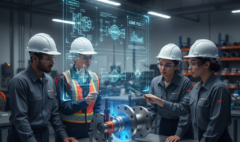
In 2026, maintenance is being redefined. We have entered the era of the Self-Healing Plant, where Agentic AI and API 579/ASME Fitness-for-Service (FFS) protocols allow assets to monitor their own degradation. “Integrity Agents” perform continuous Level 1, 2, and 3 assessments, ensuring strategic life extension and safety.
This post explores the automation of asset integrity. For engineers mastering these protocols through the [API 579/ASME Fitness-for-Service (FFS)] course, the 2026 landscape offers the opportunity to transition to strategic life extension.
1.0 The Shift to Proactive Integrity
1.1 Why Time-Based Inspections are Failing
In 2026, standard inspection intervals have become a liability. The Integrity Agent solves this through Condition-Based Monitoring. By ingesting process data, the agent knows if a piping circuit designed per [ASME B31.3] has been subjected to a corrosion upset. This methodology, taught in [As-built Engineering in Assets Management], allows plants to safely operate years beyond their design life.
2.0 Autonomous API 579 Assessments
2.1 Calculating Remaining Life via Live Sensors
When an Integrity Agent detects thinning, it initiates an API 579 Assessment immediately. It queries [API] databases and runs FEA to determine if the flaw is acceptable. If it fails Level 2, the agent uses logic from [Pipe Stress Engineering, Advanced] for Level 3. This real-time certification provides a Safe Operating Envelope to keep the plant online safely.
3.0 Conclusion
The focus is shifting to Robotic Repair Integration where AI agents will coordinate repair drones autonomously. The plant of the future will heal itself. By building expertise in [As-built Engineering] and FFS, you ensure your place at the forefront of this industrial evolution.