![[A human lead engineer in a high-tech construction command center directing a team of digital AI agents in 2026]](https://learning.malyomar.com/wp-content/uploads/2026/01/collaborative-ai-construction-leadership-1170x600.png)
Collaborative AI: How Human Engineers Lead Multi-Agent Systems in Construction
The Rise of Agentic AI in Process Plant Design: Automation and Digital Twins in 2026

![[A futuristic 3D visualization of a refinery with AI agent nodes and digital twin overlays in 2026]](https://learning.malyomar.com/wp-content/uploads/2026/01/agentic-ai-process-plant-design-roadmap.png)
![[AI agent performing a real-time ASME B31.3 and Section VIII compliance audit on a pressure vessel design]](https://learning.malyomar.com/wp-content/uploads/2026/01/automated-asme-compliance-audit-1024x1024.png)
![[A physical process plant and its living digital twin synchronized with real-time AI and IoT data streams in 2026]](https://learning.malyomar.com/wp-content/uploads/2026/01/digital-twin-living-assets-2026-1024x1024.png)
![[AI agents integrating with CAESAR II for generative pipe stress optimization and support placement in 2026]](https://learning.malyomar.com/wp-content/uploads/2026/01/caesar-ii-ai-stress-analysis-1024x683.png)
![[AI-driven design and safety monitoring for an ASME B31.12 hydrogen piping network in 2026]](https://learning.malyomar.com/wp-content/uploads/2026/01/asme-b31-12-hydrogen-infrastructure-1024x683.png)
![[AI agent assisting an engineering team with a digital FAST map and value engineering brainstorming in 2026]](https://learning.malyomar.com/wp-content/uploads/2026/01/value-engineering-ai-save-international-1024x683.png)
![[AI integrity agent performing an autonomous API 579 Fitness-for-Service audit on a corroded pipe section in 2026]](https://learning.malyomar.com/wp-content/uploads/2026/01/self-healing-plant-ai-api-579-1024x683.png)
![[A human lead engineer in a high-tech construction command center directing a team of digital AI agents in 2026]](https://learning.malyomar.com/wp-content/uploads/2026/01/collaborative-ai-construction-leadership-1024x683.png)
![[A visual representation of an engineer bridging the gap between traditional textbooks and futuristic digital AI interfaces in 2026]](https://learning.malyomar.com/wp-content/uploads/2026/01/upskilling-mechanical-engineering-ai-683x1024.png)
![[A global network of glowing engineering hubs connected by AI data streams, symbolizing the scaling of autonomous automation in 2027]](https://learning.malyomar.com/wp-content/uploads/2026/01/scaling-agentic-ai-engineering-roadmap-1024x683.png)
Collaborative AI: How Human Engineers Lead Multi-Agent Systems in Construction
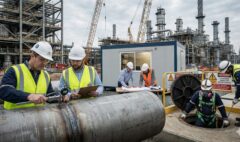
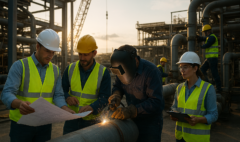
The construction site of 2026 has transitioned to a high-orchestration environment driven by Multi-Agent Systems (MAS). Today, Agentic AI has bridged the gap from design to the field, creating a seamless flow of intelligence. However, the most critical element is Engineering Leadership. Human engineers have evolved into Agentic Directors, orchestrating digital agents that manage procurement and safety in real-time.
This post explores the collaborative framework between human expertise and AI during construction. For professionals specializing in [The Roles of Piping Engineers during Construction], the ability to lead these hybrid teams is the definitive skill of the 2026 era.
1.0 The Agentic Command Center
1.1 Orchestrating Specialized Agents
In 2026, the Lead Piping Engineer oversees a fleet of agents dedicated to specific project pillars. The Procurement Agent monitors supply chains and [API] availability, while the Design Agent ensures field changes remain compliant with [ASME B31.3]. This orchestration allows for Predictive Construction, where agents simulate the next 48 hours to identify SIMOP risks. This proactive management is taught in the [Professional Piping Lead Engineer] course.
2.0 Managing the Handoff
2.1 Human-AI Collaboration Protocols
While AI optimizes, professional accountability remains with the human engineer through Guardrail Protocols. The human defines non-negotiable safety parameters the AI must follow. This HITL system ensures AI never compromises integrity. The agent provides options, but the human provides authorization. By mastering these handoffs in [The Roles of Piping Engineers during Construction], professionals ensure the AI acts as a force multiplier.
3.0 Conclusion
The 2026 Piping Lead is a Digital Orchestrator. Leading a multi-agent system requires a blend of engineering wisdom and data management. By building your foundation through [Professional Piping Lead Engineer] training, you prepare to command the most advanced construction workflows in history.