Development Phase
Value Engineering




Introduction
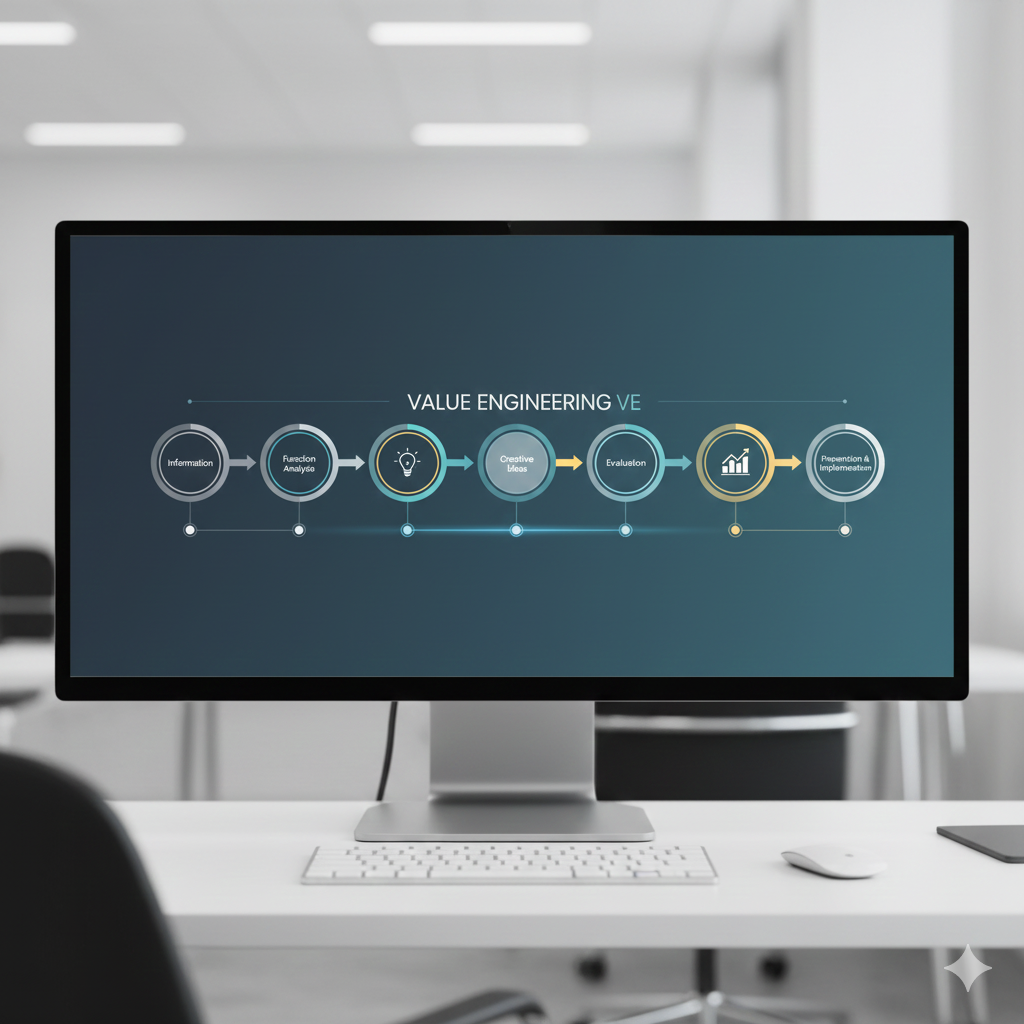
The Development Phase is where ideas become reality. After evaluation has narrowed the field to a shortlist of promising alternatives, the team must now refine those concepts into implementable solutions. This phase involves technical detailing, economic validation, risk mitigation, and planning for execution. It is the bridge between theory and practice, ensuring that recommendations can be built, procured, and operated without eroding the value achieved in earlier phases.
Purpose of the Development Phase
- Refine designs: Provide sufficient technical detail for procurement and execution.
- Validate performance: Through analysis, simulation, or pilot testing.
- Confirm economics: Update cost estimates and lifecycle models.
- Plan execution: Define schedule, resources, risks, and change management.
- Secure alignment: Ensure stakeholders are confident in readiness for implementation.
This phase answers: “How do we make the selected ideas real?”
Process Steps (Checklist)
- Define scope and interfaces
Clarify boundaries, dependencies, and integration points with existing systems. - Technical refinement
Prepare calculations, drawings, and specifications; confirm performance margins relative to constraints. - Economic validation
Update CapEx/OpEx estimates, NPV, and payback; include contingency and risk allowances. - Risk mitigation planning
Identify execution risks; assign owners and mitigation actions. - Pilot or proof-of-concept (if needed)
De-risk novel technologies or site conditions with small-scale trials. - Implementation plan
Develop schedule, resource allocation, procurement strategy, QA/QC, and commissioning steps. - Stakeholder alignment
Conduct workshops to resolve concerns and document approvals.
Tools and Templates
- Design development checklist
- Cost estimate workbook (assumptions, unit rates, contingencies)
- Risk mitigation plan (owners, timelines, triggers)
- Implementation Gantt chart (milestones, dependencies)
- Change impact assessment (operations, maintenance, training needs)
Deliverables and Acceptance Criteria
- Technical dossier: Drawings, specifications, calculations, validation results.
- Cost and economics report: Updated estimates with sensitivity analysis.
- Risk and implementation plan: Actions, schedule, resource needs.
Acceptance criteria:
- Design meets functional targets and constraints.
- Estimate class and assumptions documented.
- Stakeholder sign-off for execution readiness.
Common Pitfalls
- Scope creep: Adding non-essential features that erode value.
- Under-tested novelty: Insufficient validation of new technologies.
- Estimate optimism: Ignoring learning curves or supply variability.
- Weak change management: Operations not prepared; benefits diluted.
Example (Mini Case)
A modular heat recovery concept advanced from evaluation to development. The team refined exchanger specifications, validated performance via CFD simulations, and piloted a small module to test fouling behavior. An updated cost model with conservative contingencies still showed a 2.4-year payback. A phased implementation plan minimized downtime, securing stakeholder approval and ensuring smooth rollout.
![[AI agent assisting an engineering team with a digital FAST map and value engineering brainstorming in 2026]](https://learning.malyomar.com/wp-content/uploads/2026/01/value-engineering-ai-save-international-240x142.png)