Industrial Powerhouse: Why Sulfur Still Drives Modern Energy and Chemical Industries

Industrial Powerhouse: Why Sulfur Still Drives Modern Energy and Chemical Industries
Industrial Powerhouse: Sulfur in Modern Applications



1.0 Introduction: Sulfur — The Overlooked Industrial Backbone
Ask most people what sulfur is good for, and they will struggle past matches and rotten eggs. Yet sulfur, in its industrial form, sits quietly behind the global economy — moving fertilizer to farmland, fuel through refineries, and metal through processing plants. Industrial production of sulfur now exceeds 70 million tonnes a year, and the overwhelming majority of it never starts life as mined ore. It is recovered, almost as an afterthought, from the oil and gas industry’s own waste streams.
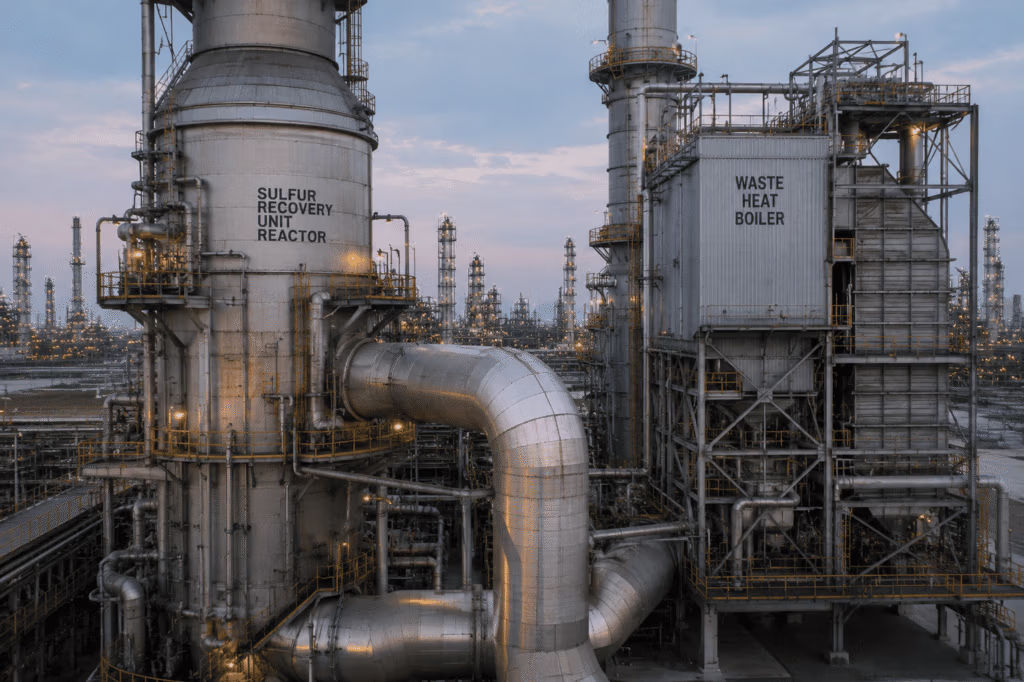
That afterthought has become one of the most tightly regulated, engineering-intensive processes in modern industry. Recovering sulfur cleanly, safely, and efficiently from sour gas and crude oil is now a compliance requirement, not an option, in nearly every refining and gas-processing jurisdiction on earth. The equipment, piping, and materials involved must survive a uniquely hostile combination of heat, corrosion, and reactive chemistry.
This is the opening post in a four-part series exploring sulfur’s industrial footprint: where it comes from, how it becomes sulfuric acid and fertilizer, what it does to the equipment that handles it, and how engineering teams keep sulfur-handling assets safe and compliant over decades of service. By the end of the series, you will understand sulfur not as a footnote chemical, but as a process stream that demands the same engineering rigor as any pressure system in your plant.
1.1 Where Industrial Sulfur Comes From
1.1.1 Natural Deposits vs. Recovered Sulfur
Sulfur mining once dominated supply, particularly through the Frasch process, which used superheated water to melt underground sulfur deposits and pump them to the surface. That method has largely disappeared from major producing regions because it cannot compete economically with a far cheaper alternative: sulfur that refineries and gas plants are already required to remove from their feedstocks.
1.1.2 Sulfur Recovery from Sour Gas and Crude Oil
Crude oil and natural gas frequently contain hydrogen sulfide (H2S) and other sulfur compounds. Left untreated, these compounds corrode pipelines, poison catalysts, and produce sulfur dioxide emissions when burned. Refineries and gas plants extract this sulfur through hydrotreating and amine-treating processes, then convert the recovered H2S into elemental sulfur — typically through the Claus process, which we cover in depth in Post 2 of this series. Today, recovered sulfur accounts for the vast majority of global supply, which means sulfur production volumes track refining and gas-processing activity almost directly.
1.2 Why Sulfur Matters to the Global Economy
1.2.1 Link to Fertilizer Production
Roughly half of the world’s sulfur output is converted into sulfuric acid, and most of that acid feeds phosphate fertilizer production. Without a reliable sulfur supply chain, global food production capacity would face a direct constraint — a connection most people outside the chemical industry never make.
1.2.2 Link to the Energy Transition
Tightening fuel sulfur specifications — from IMO 2020 marine fuel rules to ultra-low-sulfur diesel standards — have pushed refineries to remove more sulfur from fuels than ever before, increasing the load on sulfur recovery units. At the same time, hydrogen production and carbon capture projects are introducing new sulfur-management challenges into facilities that never had to deal with them before.
1.2.3 Sulfur as a Leading Indicator of Industrial Activity
Because so much sulfur is recovered rather than mined, sulfur production volumes are often used as a rough proxy for refining and gas-processing throughput — when refineries run harder, more sulfur comes out the back end.
1.3 Sulfur’s Industrial Applications at a Glance
Beyond sulfuric acid and fertilizer, elemental sulfur and its derivatives show up across a wide range of industries:
- Petroleum refining, as a feedstock for catalysts and processing aids
- Rubber vulcanization, where sulfur cross-links polymer chains for tire and industrial rubber manufacturing
- Pharmaceuticals and agrochemicals, as a synthesis input
- Battery technology, including emerging sulfur-based energy storage chemistries
- Construction materials, such as sulfur concrete for corrosion-resistant applications
This breadth is exactly why sulfur deserves more engineering attention than it typically gets — it is not a niche specialty chemical, but a thread running through multiple industrial supply chains simultaneously.
1.4 The Engineering Challenge: Handling a Corrosive, Reactive Element
1.4.1 Sour Service and Material Degradation
Equipment exposed to H2S and sulfur compounds is classified as operating in “sour service,” a designation that triggers specific material selection, hardness, and inspection requirements. Left unmanaged, sour service environments cause sulfide stress cracking, hydrogen-induced cracking, and accelerated corrosion — failure mechanisms that have caused some of the industry’s most serious process safety incidents. We dedicate Post 4 of this series entirely to these mechanisms and how integrity management programs address them.
1.4.2 Safety and Emissions Considerations
H2S is acutely toxic, and SOx emissions from incomplete sulfur recovery carry significant environmental and regulatory consequences. This dual hazard — to personnel and to compliance status — is why sulfur recovery and handling systems receive disproportionate engineering and regulatory scrutiny relative to their size within a typical process plant.
1.5 What’s Next in This Series
- Post 2 walks through the Claus process step by step and the mechanical/piping design considerations specific to sulfur recovery units.
- Post 3 covers how recovered sulfur becomes sulfuric acid, and the equipment engineering behind acid plants.
- Post 4 focuses on corrosion mechanisms, materials selection, and asset integrity management in sour and sulfur service.
1.6 Conclusion
Sulfur’s industrial story is one of transformation — from an unwanted contaminant to an economically essential commodity, and from a simple chemical to a serious engineering challenge. Understanding how sulfur is recovered, processed, and managed gives engineers a clearer view of where corrosion risk, compliance pressure, and process safety concerns concentrate in oil, gas, and chemical facilities.
Want to go deeper on the materials and design challenges sulfur service creates? Our Materials and Design for High Temperatures course and API 579/ASME Fitness-for-Service (FFS) course give engineering teams the practical tools to design and maintain assets in demanding sulfur and sour-service environments.
Recommended Training Courses
External References
1.7 FAQ
Q1: Is most industrial sulfur mined or recovered from oil and gas processing?
The large majority is recovered as a byproduct of refining and natural gas processing, primarily through the Claus process, rather than mined directly.
Q2: Why is sulfur dioxide emission control so tightly regulated?
SOx emissions contribute to acid rain and respiratory health risks, prompting strict regulatory limits on sulfur recovery efficiency at refineries and gas plants.
Q3: What does “sour service” mean for equipment design?
It means the equipment is exposed to H2S and must be designed, fabricated, and inspected to resist sulfide stress cracking and hydrogen-induced cracking, often per ASME and API material guidance.
Q4: How is sulfur connected to fertilizer production?
Most sulfur is converted to sulfuric acid, which is a key input for phosphoric acid and phosphate fertilizer manufacturing.
Q5: Why does sulfur recovery matter more now than a decade ago?
Tightening fuel sulfur specifications and new hydrogen/carbon-capture projects are increasing both the volume and complexity of sulfur management at industrial facilities.