Corrosion, Integrity, and Asset Management in Sulfur and Sour Service
Industrial Powerhouse: Sulfur in Modern Applications



4.0 Introduction: When Sulfur Turns Against Your Assets
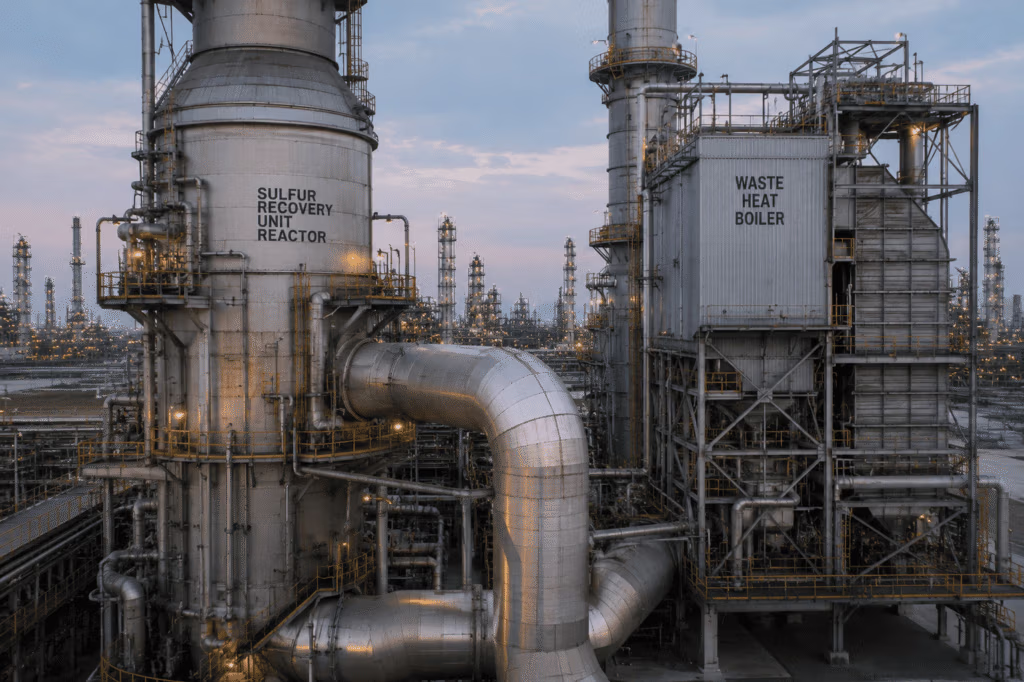
The first three posts in this series traced sulfur’s path from waste gas to recovery, then to sulfuric acid and the industries it feeds. This final post addresses the other side of that story: what sulfur and its compounds do to the steel, alloys, and welds that contain them over years and decades of service. Sour and sulfur-bearing environments are responsible for some of the industry’s most consequential equipment failures, and the engineering response to that risk — materials selection, inspection, and integrity management — deserves the same attention as the process design covered earlier in this series.
Understanding these degradation mechanisms is not an academic exercise. Sulfide stress cracking and hydrogen-induced cracking have caused pipeline ruptures, vessel failures, and fatalities across the industry’s history, which is precisely why sour service design and inspection requirements are written into recognized codes and standards rather than left to individual engineering judgment. This post walks through the core corrosion mechanisms, the materials strategies used to manage them, and how a proactive integrity management program keeps sulfur-handling assets safe over their full operating life.
4.1 Understanding Sour Service Corrosion Mechanisms
4.1.1 Sulfide Stress Cracking (SSC)
Sulfide stress cracking occurs when hydrogen atoms, generated by the corrosion reaction between H2S and steel, diffuse into susceptible high-hardness microstructures under tensile stress, producing brittle cracking that can occur with little warning. SSC is particularly dangerous because it can affect components that otherwise appear undamaged, making hardness control during fabrication and welding a critical preventive measure rather than an afterthought.
4.1.2 Hydrogen-Induced Cracking (HIC)
Unlike SSC, hydrogen-induced cracking does not require applied stress — atomic hydrogen generated by the sour corrosion reaction diffuses into the steel and recombines at internal inclusions or laminations, generating internal pressure that can blister or crack the material from within. HIC is especially associated with older or lower-quality steel plate containing significant inclusion content, which is why modern sour service material specifications place strict limits on sulfur content and inclusion morphology in the base steel itself.
4.1.3 Sulfidation and High-Temperature Attack
At elevated temperatures — common in sulfur recovery units and acid plant furnaces — sulfur compounds attack metal surfaces directly through sulfidation corrosion, a mechanism distinct from the hydrogen-driven cracking seen at lower temperatures. Sulfidation rates depend heavily on temperature, alloy composition, and sulfur species concentration, which makes high-temperature sulfur service one of the more condition-specific corrosion problems engineers encounter.
4.2 Materials Selection Strategies
4.2.1 Industry Guidance for Sour Environments
Materials selection for sour service is governed by well-established industry guidance defining acceptable hardness limits, material qualification testing, and environmental limits within which carbon and low-alloy steels can be safely used. Engineers working outside those defined limits typically need to step up to more resistant alloys or implement additional mitigation measures, since pushing standard materials beyond their qualified envelope is a recognized root cause in sour service failure investigations.
4.2.2 Alloy and Coating Choices for Sulfur-Handling Equipment
Where standard carbon steel cannot meet sour service or high-temperature sulfidation requirements, designers turn to chromium-molybdenum alloys, stainless steels, or specialized coatings and linings depending on the specific temperature, concentration, and stress conditions involved. The right choice is rarely the most resistant material available by default — over-specifying alloy content adds cost without necessarily improving reliability, so material selection should be matched precisely to the service conditions identified during process and corrosion engineering review.
4.3 Inspection, Fitness-for-Service, and Asset Integrity
4.3.1 Inspection Intervals and Techniques
Sour and sulfur service equipment typically requires more frequent and more targeted inspection than equivalent equipment in benign service, often combining ultrasonic thickness monitoring, wet fluorescent magnetic particle inspection for surface cracking, and periodic internal visual inspection at known high-risk locations. Inspection planning benefits significantly from documented knowledge of where specific degradation mechanisms are most likely to occur within a given system, rather than applying generic interval-based inspection across the board.
4.3.2 Fitness-for-Service Assessment Basics
When inspection identifies corrosion, cracking, or other damage, fitness-for-service methodology provides an engineering basis for determining whether equipment can continue operating safely, for how long, and under what conditions, rather than defaulting to immediate replacement. This approach — formalized in widely used fitness-for-service standards — has become a standard part of asset integrity programs across the refining and chemical industries, balancing safety with the practical and economic realities of continued operation.
4.3.3 Repair and Life-Extension Strategies
Where fitness-for-service assessment identifies a need for intervention, options range from weld repair and re-rating to the application of engineered composite repairs for certain damage types, each with its own qualification requirements and limitations. Choosing the right repair strategy depends on damage mechanism, location accessibility, and remaining service life requirements — a decision that benefits from close coordination between inspection, materials, and mechanical engineering disciplines.
4.4 Building a Proactive Integrity Management Program
4.4.1 Risk-Based Inspection Principles
Risk-based inspection (RBI) programs prioritize inspection resources according to both the likelihood and consequence of failure for each piece of equipment, allowing facilities to focus the most rigorous inspection effort on the highest-risk sulfur and sour-service assets rather than spreading resources evenly. This risk-weighted approach has become the dominant inspection planning methodology across major refining and chemical operators precisely because it aligns inspection spend with actual risk exposure.
4.4.2 Lessons from Industry Incidents
Past sour service failures consistently point to a common pattern: gaps between known degradation mechanisms and actual inspection or material qualification practice, often driven by incomplete process knowledge transfer between design and operations teams. Building integrity management programs that explicitly document sour service exposure, qualified material limits, and inspection rationale closes exactly this gap, turning institutional knowledge into a durable, auditable system rather than something that lives only in experienced staff members’ memory.
4.5 Conclusion
Sulfur’s industrial value, covered throughout this series, comes with a corrosion and integrity management burden that engineering teams must take as seriously as the process chemistry itself. Sulfide stress cracking, hydrogen-induced cracking, and sulfidation are well-understood mechanisms with established mitigation strategies — but only when materials selection, inspection planning, and fitness-for-service assessment are applied deliberately and documented thoroughly across an asset’s operating life.
Ready to build your team’s capability in sour service materials selection and fitness-for-service assessment? Explore our API 579/ASME Fitness-for-Service (FFS) course and Inspection, Repair and Alterations of In Service Pressure Equipment course to strengthen your integrity management program.
Recommended Training Courses
- API 579/ASME Fitness-for-Service (FFS)
- Inspection, Repair and Alterations of In Service Pressure Equipment
External References
4.6 FAQ
Q1: What is the difference between sulfide stress cracking and hydrogen-induced cracking?
SSC requires applied tensile stress combined with hydrogen embrittlement of susceptible microstructures, while HIC occurs without applied stress as hydrogen accumulates at internal steel inclusions, both driven by the same underlying sour corrosion reaction.
Q2: Why does material hardness matter so much in sour service?
Higher-hardness microstructures are more susceptible to sulfide stress cracking, which is why sour service material specifications place strict limits on hardness for both base metal and weld heat-affected zones.
Q3: What is fitness-for-service assessment used for?
It provides an engineering basis for determining whether damaged equipment can continue operating safely, and under what conditions, rather than requiring automatic replacement upon finding any defect.
Q4: What is risk-based inspection and why is it widely used?
RBI prioritizes inspection effort according to both failure likelihood and consequence, allowing facilities to focus resources on their highest-risk equipment rather than applying uniform inspection intervals across all assets.
Q5: Why are sour service failures still occurring despite well-known mechanisms?
Most documented incidents trace back to gaps between known degradation mechanisms and actual material qualification or inspection practice, often linked to incomplete knowledge transfer rather than a lack of available engineering guidance.