Process Plant Layout and Piping Design, Level-III
What you'll learn
Implement Design Strategy: Develop and enforce a comprehensive Basis of Design (BOD) for layout, driving standardization and compliance across the project.
Manage Brownfield Constraints: Master the advanced planning and execution required for integrating new piping systems into existing plant infrastructure (Brownfield projects), minimizing shutdown time and maximizing safety.
Optimize Project Cost (Value Engineering): Apply Value Engineering (VE) principles to layout decisions to achieve quantifiable reductions in CAPEX (material costs) and OPEX (maintenance and energy costs).
Lead Safety and Review Workshops: Effectively participate in and lead HAZOP, SIL, and advanced 3D Model Review sessions, driving corrective actions that resolve critical risks.
Validate Stress Analysis Feedback: Critically review the Stress Analysis Report to ensure the final layout satisfies mechanical integrity requirements and manage design iteration cycles efficiently.
Develop Modularization Plans: Evaluate the technical feasibility and cost benefits of modularization and offsite fabrication for large sections of the plant.
Featured
Piping Flexibility and Support
What you'll learn
Paving the way of piping designer to consider code provision.
Provide mandatory introduction to piping stress engineering.
Complete awareness on piping supporting system for construction and maintenance engineers.
Intermediate
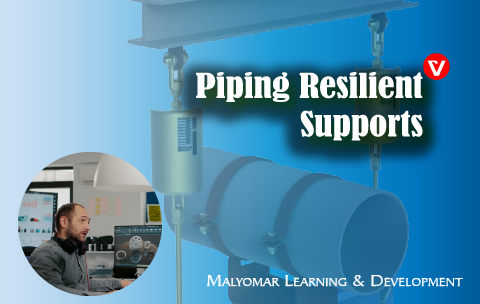
Piping Resilient Supports. Selection, Spec’s, Procurement, Installation and Maintenance
$480
Piping Resilient Supports. Selection, Spec’s, Procurement, Installation and Maintenance
What you'll learn
Covers the whole cycle of resilient support, starting by design and ends at maintenance.
Understanding the true function and clear the popular myth.
Change the focus on pipe support from just a member to important asset.

Pipe Stress analysis and supporting systems for piping designers
What you'll learn
Eliminate Design Iterations: Proactively design layouts that meet mechanical requirements, directly reducing costly communication loops and eliminating re-work cycles between the Piping Design and Stress Analysis teams.
Translate Code to CAD: Gain the essential knowledge of stress analysis criteria (e.g., thermal flexibility, support span limits) and learn to implement these ASME B31 code rules directly within your 3D modeling environment.
Master Load Vector Generation: Understand precisely how your layout decisions (routing, branch connections, component weight) directly translate into critical load vectors that determine the compliance of the entire system.
Optimize Support System Placement: Select and place piping support systems not just for weight, but to effectively control displacement and manage moment loads, making the system inherently mechanically sound from the initial draft.
Accelerate Deliverable Approval: Structure and prepare piping deliverables (Isometrics, Plan Views) to proactively address the stress engineer's needs, leading to faster review cycles and accelerated project turnover.
Validate Constructability & Compliance: Achieve true engineering synergy by ensuring your designs are simultaneously constructable, cost-efficient, and fully compliant with ASME flexibility and sustained stress limits.

Pipe Stress Engineering-Academic foundation
What you'll learn
Differentiate between properties of various engineering materials.
Apply fundamental principles of stress, strain, and material failure theories.
Perform stress analysis on different structural components.
Utilize Finite Element Analysis (FEA) software for complex problems.
Analyze thermal, static, and dynamic loads.
Develop a strong theoretical foundation for specialized fields like pipe stress analysis.

Pipe Stress Engineering, Static
What you'll learn
Execute the accurate geometric and topological discretization of the pressure envelope and ancillary components within the CAESAR II
Define and integrate the set of time-invariant static load vectors
Conduct a rigorous tensor evaluation of primary and secondary stresses
Nozzle and Support Reaction Profiling
Resolve the effects of non-linear boundary conditions
Validate the mechanical integrity compliance margin
Drafting hardware technical specification
Moving among Compliance, Value and Energy
Master the final phase of analysis, producing irrefutable, audit-proof documentation.

Roles of Piping Engineers during construction of petrochemical plants
What you'll learn
Analyze Construction Contracts: Differentiate between common construction contract types (e.g., EPC, Lump Sum, Cost Plus) and understand their impact on engineering scope and risk management.
Manage Field Engineering: Effectively resolve non-conformance issues, manage field design changes, and ensure the accuracy of as-built documentation.
Control Budget and Cost: Monitor piping installation progress against the budget, track material usage (MTO reconciliation), and evaluate potential cost overruns.
Oversee Quality and Inspection: Define and implement robust Quality Control (QC) plans, manage welding procedures, and coordinate mandatory pressure testing and NDT inspection activities.
Align Project Planning: Understand the principles of construction sequencing and scheduling to align engineering deliverables (Isometrics, Line Lists) with the contractor's execution plan.
Lead Field Supervision: Guide and mentor field teams, enforce project specifications, and ensure strict adherence to Health, Safety, and Environment (HSE) protocols during piping installation.

Process Plant Layout and Piping Design, Level – I
What you'll learn
Interpret Engineering Documents: Effectively read and utilize core piping design documents, including PFDs, P&IDs, and Isometric drawings.
Identify Components: Differentiate and select standard piping components (valves, fittings, flanges) and understand their functions within the system.
Apply Layout Principles: Execute preliminary Plot Plan and Equipment Layout based on functional and safety criteria.
Establish Design Constraints: Identify and apply the primary constraints that dictate pipe routing (e.g., access, maintenance, thermal expansion).
Determine Clearances: Apply industry standards to determine minimum clearances, spacing, and accessibility requirements for various equipment types.
Communicate Design Intent: Structure and present design information clearly for effective communication with structural, mechanical, and stress engineering teams.
- 1
- 2