Hydropower & Marine Energy
Renewable Energy






Introduction
Hydropower is the backbone of renewable baseload. Unlike solar or wind, hydro can provide continuous power and acts as a massive battery for the grid. In this post, we look at established hydro technologies and the new frontier: marine energy.
Purpose: The Water Battery
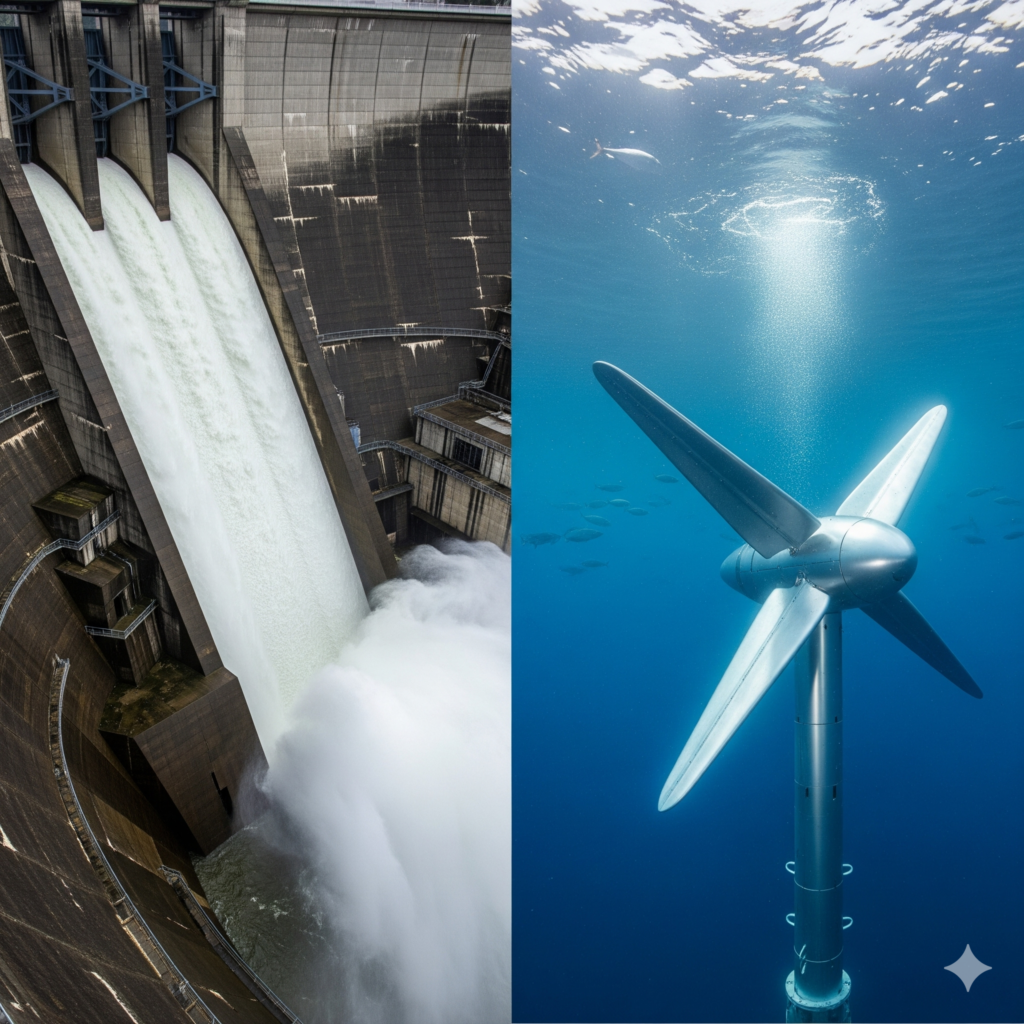
Hydropower converts the potential energy of water (head) into kinetic energy to spin a turbine.
- Baseload Power: It provides grid stability (inertia) that inverter-based renewables (solar/wind) often cannot.
- Storage: Pumped Hydro Storage accounts for over 90% of the world’s energy storage capacity, pumping water uphill when energy is cheap and releasing it when demand peaks.
Types of Hydropower
- Reservoir (Dam): Stores water for on-demand release. High environmental impact but high reliability.
- Run-of-River: Diverts a portion of a river flow through a penstock. No massive reservoir, meaning less environmental footprint but highly dependent on seasonal rainfall.
The New Frontier: Marine Energy
- Tidal Energy: Uses the gravitational pull of the moon. It is the only perfectly predictable renewable energy.
- Wave Energy: Captures the motion of surface waves. Still in the R&D phase due to the harshness of the ocean environment destroying equipment.
Process Steps: Developing Hydro
- Hydrological Study: Measuring flow duration curves (how much water is available throughout the year).
- Head Measurement: Determining the vertical drop. Power = Density × Gravity × Flow × Head × Efficiency.
- Environmental Impact Assessment (EIA): Critical for protecting fish migration and sediment transport.
Common Pitfalls
- Sedimentation: Dams trap silt, reducing reservoir capacity over decades and starving downstream ecosystems of nutrients.
- Methane Emissions: Organic matter rotting in shallow, warm reservoirs can release significant greenhouse gases.
Example: The Pumped Storage Revitalizion
As solar penetration increases, old pumped hydro stations are being upgraded with variable-speed turbines. This allows them to react faster to grid fluctuations, essentially acting as a giant shock absorber for the renewable grid.